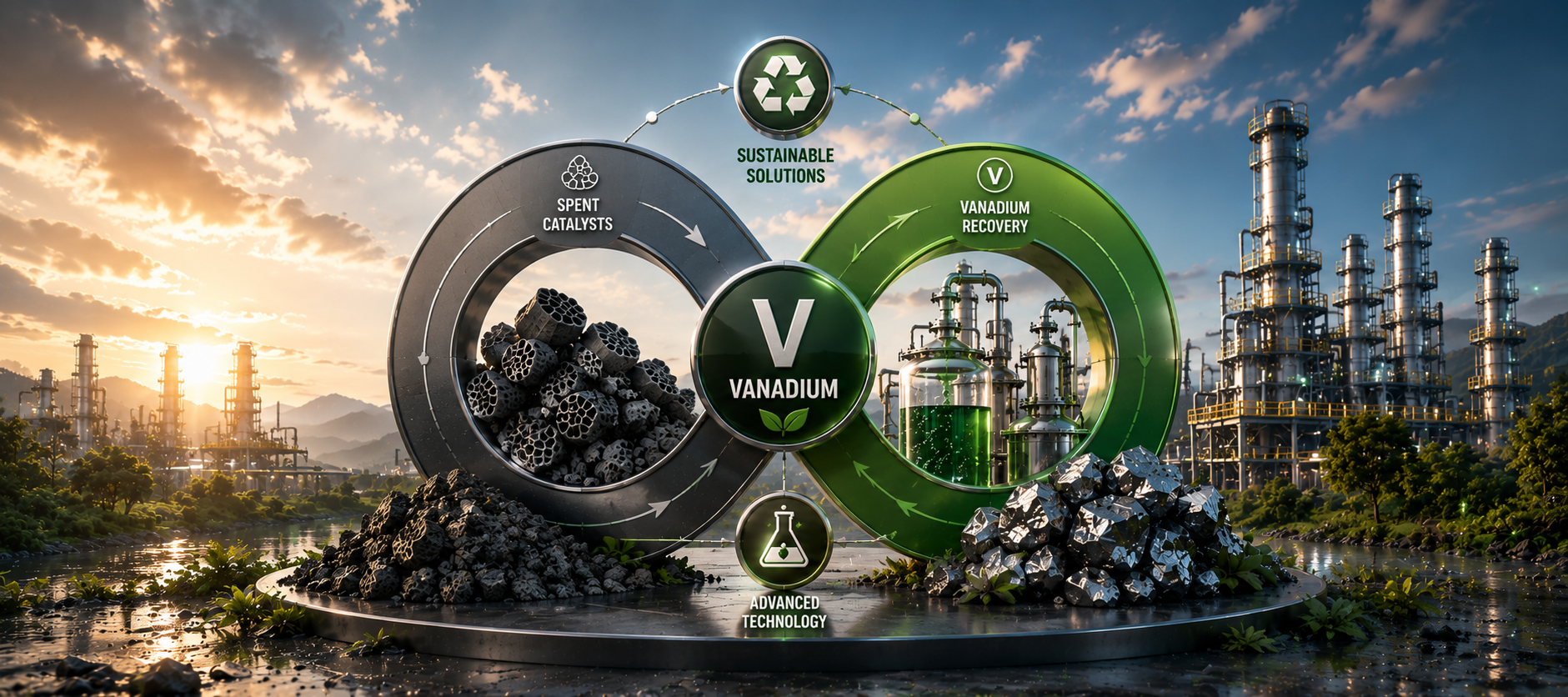
Spent catalysts from the petrochemical and chemical industries represent one of the most promising feedstocks for vanadium recovery. These catalysts, used in processes such as fluid catalytic cracking (FCC), hydrotreating, and ammonia synthesis, contain significant concentrations of vanadium, molybdenum, nickel, and cobalt — often at levels that exceed the grades of primary ores.
Recovering vanadium from spent catalysts is not only economically attractive but also environmentally essential. These residues are classified as hazardous waste due to their metal content and toxic compounds, making their safe disposal costly and complex. By processing spent catalysts through advanced recovery technologies, we can transform a waste liability into a valuable resource, contributing to circular supply chains and reducing environmental impact.
Understanding Spent Catalysts
Catalysts are used extensively in the oil refining and chemical industries to accelerate chemical reactions without being consumed in the process. Over time, catalysts lose their activity due to the accumulation of carbon deposits, metal poisoning, and thermal degradation. When they can no longer be regenerated economically, they are classified as "spent" and require disposal or recycling.
Spent catalysts can contain:
- Vanadium: 2–8% V₂O₅ in FCC catalysts, often in combination with nickel, iron, and rare earth elements.
- Molybdenum: 5–15% MoO₃ in hydrotreating catalysts, often accompanied by cobalt or nickel.
- Nickel and Cobalt: 2–10% NiO and CoO in many hydroprocessing catalysts.
- Alumina: The primary support material, which can also be recovered as a valuable refractory or chemical product.
The high metal content of spent catalysts makes them an economically attractive secondary resource, particularly as primary ore grades decline and processing costs increase.
“Spent catalysts are a prime example of urban mining. They contain valuable metals at grades that would be considered high‑grade in primary mining, yet they are often disposed of as waste. This is a missed opportunity — both economically and environmentally.” — Dr. Robert Chen, Catalyst Recycling Specialist
Technical Approaches to Vanadium Recovery
Several established and emerging technologies are used to recover vanadium from spent catalysts. The choice of technology depends on the catalyst type, metal composition, and desired product purity. The most common approaches include:
1. Hydrometallurgical Processing
Hydrometallurgy is the most widely used method for recovering vanadium from spent catalysts. The process typically involves the following steps:
- Roasting: Spent catalysts are roasted at 400–800°C to remove carbon deposits, oxidize metals, and convert vanadium to soluble forms such as vanadium pentoxide or sodium vanadate. Alkali roasting (with sodium carbonate or sodium chloride) is commonly used to enhance vanadium solubility.
- Leaching: The roasted material is leached with water, acid, or alkali to dissolve the vanadium. Sulfuric acid leaching is the most common, producing a pregnant leach solution containing vanadium, molybdenum, nickel, and other metals.
- Solvent Extraction (SX): Vanadium is selectively extracted from the leach solution using organic extractants. This step separates vanadium from impurities such as iron, aluminum, and nickel.
- Stripping and Precipitation: The vanadium is stripped from the organic phase and precipitated as ammonium metavanadate, vanadium pentoxide, or other high‑purity vanadium products.
Hydrometallurgical routes can achieve vanadium recoveries of over 90% and produce products with purities exceeding 98% V₂O₅.
2. Pyrometallurgical Processing
High‑temperature processing is also used, particularly when the catalysts contain significant amounts of sulfur or carbon that need to be removed. Pyrometallurgical routes include:
- Smelting: The spent catalysts are melted in a furnace, where vanadium is partitioned into a metal or slag phase. This method is less selective than hydrometallurgy but can handle a wider range of feedstocks.
- Chlorination: The catalysts are reacted with chlorine gas at high temperatures to form volatile vanadium chlorides, which are then condensed and purified.
- Reduction Roasting: Similar to the roasting step in hydrometallurgy, but followed by magnetic separation to recover metal values.
3. Ion Exchange (IX)
Ion exchange is increasingly used for polishing streams in vanadium recovery, particularly where very high purity is required. IX resins selectively adsorb vanadium ions from solution, allowing for the production of ultra‑high‑purity products.
4. Combined and Hybrid Processes
The most effective recovery flowsheets often combine multiple technologies. For example:
- Roasting + Leaching + SX: The classic hydrometallurgical route, offering high recovery and product purity.
- Roasting + Leaching + IX: Used when extremely high purity is required, such as for electronic or battery-grade vanadium.
- Physical Beneficiation + Hydrometallurgy: Pre‑concentrating the vanadium‑bearing fraction using physical methods (screening, gravity, magnetic) before hydrometallurgical processing, reducing reagent consumption and improving economics.
Cirvalor’s Vanadium Recovery Capabilities
At Cirvalor, we have extensive experience in recovering vanadium from spent catalysts. Our integrated processing facility is capable of handling a wide range of spent catalyst types, including FCC catalysts, hydrotreating catalysts, and ammonia synthesis catalysts. Our capabilities include:
- Flexible Flowsheet Design: We tailor our processing routes to the specific characteristics of each spent catalyst batch, optimizing metal recovery and product quality.
- High‑Purity Products: We produce vanadium pentoxide (V₂O₅) and ammonium metavanadate (AMV) at purities exceeding 98%, meeting the most demanding specifications.
- Environmental Stewardship: Our processes are designed to minimize waste generation, maximize resource recovery, and meet the highest environmental standards.
- Circular Integration: We work with our clients to return recovered vanadium to their supply chains, creating a closed‑loop system that reduces costs and improves sustainability.
Case Study: FCC Catalyst Recycling
In a recent project, we partnered with a major oil refinery to recover vanadium from their spent FCC catalyst. The catalyst contained approximately 4% V₂O₅, 1.5% NiO, and 0.8% Sb₂O₃. Our solution included:
- Alkali Roasting: Roasting the catalyst with sodium carbonate at 700°C to convert vanadium to soluble sodium vanadate.
- Water Leaching: Leaching the roasted material with hot water to dissolve the vanadium.
- Solvent Extraction: Selective extraction of vanadium using a proprietary extractant blend, achieving >95% recovery.
- Precipitation and Calcination: Precipitating ammonium metavanadate, followed by calcination to produce high‑purity V₂O₅.
The project not only eliminated the refinery's waste disposal costs but also generated a new revenue stream and significantly improved their ESG performance.
Future Trends in Vanadium Recovery from Spent Catalysts
The future of vanadium recovery from spent catalysts is promising. Emerging trends include:
- Digitalization and Automation: AI and machine learning are being used to optimize processing conditions, improve recovery rates, and reduce costs.
- Novel Leaching Technologies: New lixiviants and leaching techniques, such as bioleaching and ultrasound‑assisted leaching, are being developed to improve the efficiency and environmental profile of vanadium recovery.
- Circular Business Models: Catalysts producers and users are exploring new partnership models to create closed‑loop supply chains that recover valuable metals and reduce reliance on primary mining.
- Increasing Demand: The growing demand for vanadium in energy storage, steel, and chemical applications is driving investment in recycling infrastructure and innovation.
At Cirvalor, we are committed to being at the forefront of these developments. Our investment in R&D, our partnerships with leading research institutions, and our relentless focus on process optimization ensure that we continue to deliver world‑class vanadium recovery solutions for our clients.
The message is clear: Spent catalysts are not waste — they are a valuable resource. With the right technology and the right partner, the petrochemical and chemical industries can turn their waste streams into strategic assets, creating economic, environmental, and social value for all.