
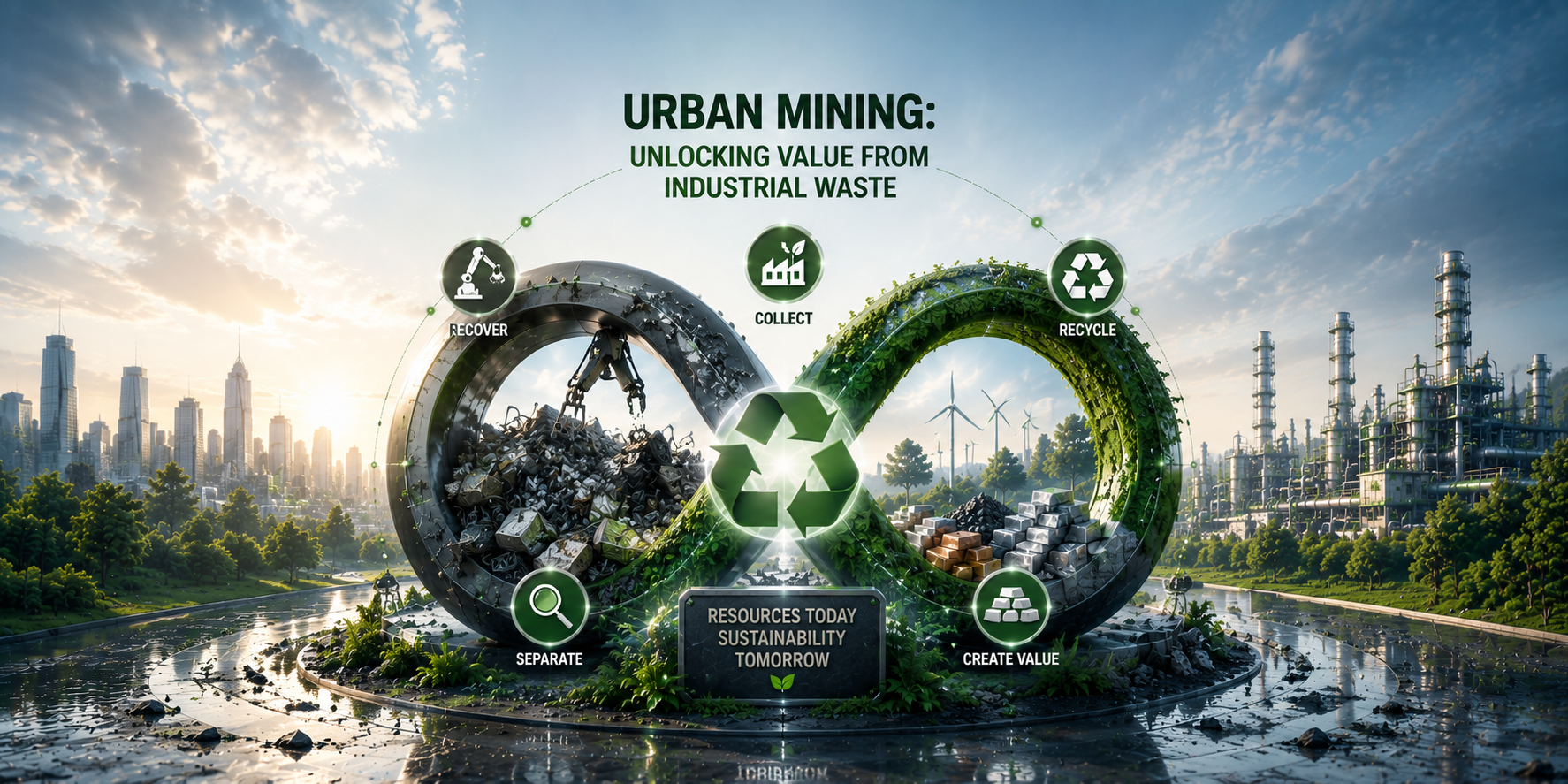
Urban mining is the process of reclaiming valuable materials from the waste streams of our cities and industries. While the term often brings to mind e‑waste and discarded consumer goods, the most significant opportunities lie in industrial waste — slag, ash, spent catalysts, and manufacturing residues that contain vast quantities of recoverable metals and minerals.
As the world transitions toward a circular economy, urban mining has emerged as a critical strategy for resource security, environmental protection, and economic resilience. Unlike traditional mining, which extracts finite resources from the earth with significant environmental impact, urban mining recovers materials that are already above ground, reducing the need for new extraction and keeping resources in productive use.
What Is Urban Mining?
Urban mining refers to the systematic recovery of materials from anthropogenic sources — the waste streams generated by human activity. These sources include:
- Industrial Waste: Slag, ash, dust, sludge, spent catalysts, and manufacturing residues.
- Construction and Demolition Waste: Concrete, steel, copper, and aluminium from buildings and infrastructure.
- Electronic Waste: Precious metals like gold, silver, and palladium from circuit boards and components.
- End‑of‑Life Products: Batteries, vehicles, appliances, and machinery.
Industrial waste is particularly attractive for urban mining because it is often generated in large, concentrated volumes at fixed locations, making collection and processing more economical. Moreover, industrial residues frequently contain high concentrations of valuable metals that can be recovered with advanced metallurgical technologies.
“Urban mining is not just about recycling. It is about redefining the concept of mining itself — shifting from extracting resources from the earth to extracting them from our own industrial history.” — Dr. Sarah Chen, Urban Mining Researcher
The Growing Importance of Industrial Urban Mining
Several factors are driving the rapid growth of industrial urban mining:
- Resource Scarcity: Depleting ore grades and increasing geopolitical risks are making primary mining less reliable and more expensive.
- Environmental Pressure: The environmental footprint of primary mining — including land disturbance, water consumption, and greenhouse gas emissions — is under increasing scrutiny from regulators, investors, and communities.
- Economic Incentives: Recovered metals and minerals can generate significant revenue, reduce disposal costs, and provide price stability compared to volatile primary commodity markets.
- Circular Economy Policies: Governments worldwide are implementing policies that mandate or incentivize the recycling and recovery of materials, creating a regulatory tailwind for urban mining.
According to a recent report by the International Resource Panel, urban mining of industrial waste could supply up to 30% of the global demand for several critical metals by 2040, including chromium, vanadium, and molybdenum.
Industrial Waste Streams with High Urban Mining Potential
1. Steel Slag
Steelmaking generates millions of tonnes of slag annually, containing recoverable quantities of iron, chromium, vanadium, and manganese. While some slag is used in construction, the recovery of metal values is often overlooked. Advanced physical beneficiation and hydrometallurgical processes can recover up to 90% of the contained metals, creating valuable feedstocks for the ferroalloy and steel industries.
2. Spent Catalysts
Refineries and chemical plants generate spent catalysts containing valuable metals like vanadium, molybdenum, nickel, cobalt, and tungsten. These residues are hazardous and costly to dispose of, making recovery economically attractive. Hydrometallurgical routes, including leaching, solvent extraction, and precipitation, are particularly effective for these feeds.
3. Fly Ash and Bottom Ash
Thermal power plants produce vast quantities of ash that contain recoverable aluminium, iron, rare earth elements, and industrial minerals. While some ash is used in cement and construction, advanced recovery technologies are unlocking higher‑value applications for these residues.
4. Refractory Waste
Spent refractory linings from furnaces, kilns, and reactors contain alumina, magnesia, chrome, and zirconia. These high‑value minerals are often discarded despite their significant recycling potential. Our recovery processes can reclaim these materials at high purity, reducing dependence on virgin raw materials.
Cirvalor’s Approach to Urban Mining
At Cirvalor, we are pioneers in industrial urban mining. Our business model is built on recovering valuable materials from the waste streams of industrial partners, creating value for both our clients and the environment. Our approach combines:
- Advanced Characterization: We analyze waste streams in detail to understand their composition, mineralogy, and recovery potential.
- Customized Processing: We design and operate tailor‑made recovery flowsheets that maximize metal recovery and product quality.
- Technology Innovation: We continuously invest in R&D to improve our processing capabilities and recover materials that were previously considered unrecoverable.
- Circular Partnerships: We work closely with our clients to integrate recovery into their operations, creating closed‑loop systems that benefit both parties.
Case Study: Recovering Chromium from Ferrochrome Slag
In a recent project, we partnered with a major ferroalloy producer to recover chromium from their slag. The slag, previously landfilled, contained significant chromium values locked in a complex matrix. Our solution combined:
- Physical Beneficiation: Crushing, grinding, and magnetic separation to pre‑concentrate the chromium.
- Hydrometallurgical Processing: Leaching, solvent extraction, and crystallization to produce high‑purity chromium oxide.
- Circular Integration: The recovered product was returned to the client’s production process, reducing their reliance on virgin chromite ore.
This project not only eliminated the client’s waste disposal costs but also generated a new revenue stream and significantly improved their environmental performance.
Looking Forward: The Future of Urban Mining
The future of urban mining is bright. As technologies improve and economic conditions become more favorable, we expect to see even greater adoption of urban mining across industries. Emerging trends include:
- Digitalization: AI and data analytics are improving the characterization and processing of complex waste streams.
- Automation and Robotics: Automated sorting and processing systems are reducing costs and improving recovery rates.
- New Business Models: Companies are exploring novel partnerships and revenue sharing models to accelerate urban mining adoption.
- Policy Support: Governments are recognizing the strategic importance of urban mining and implementing supportive policies and incentives.
At Cirvalor, we are committed to being at the forefront of this transformation. Our mission is to recover resources, build capability, and serve humanity — and urban mining is central to that vision.
The message is clear: The resources of tomorrow are already above ground — in the waste streams of today. Urban mining is not just an environmental strategy; it is a business imperative for a resource‑constrained world.