
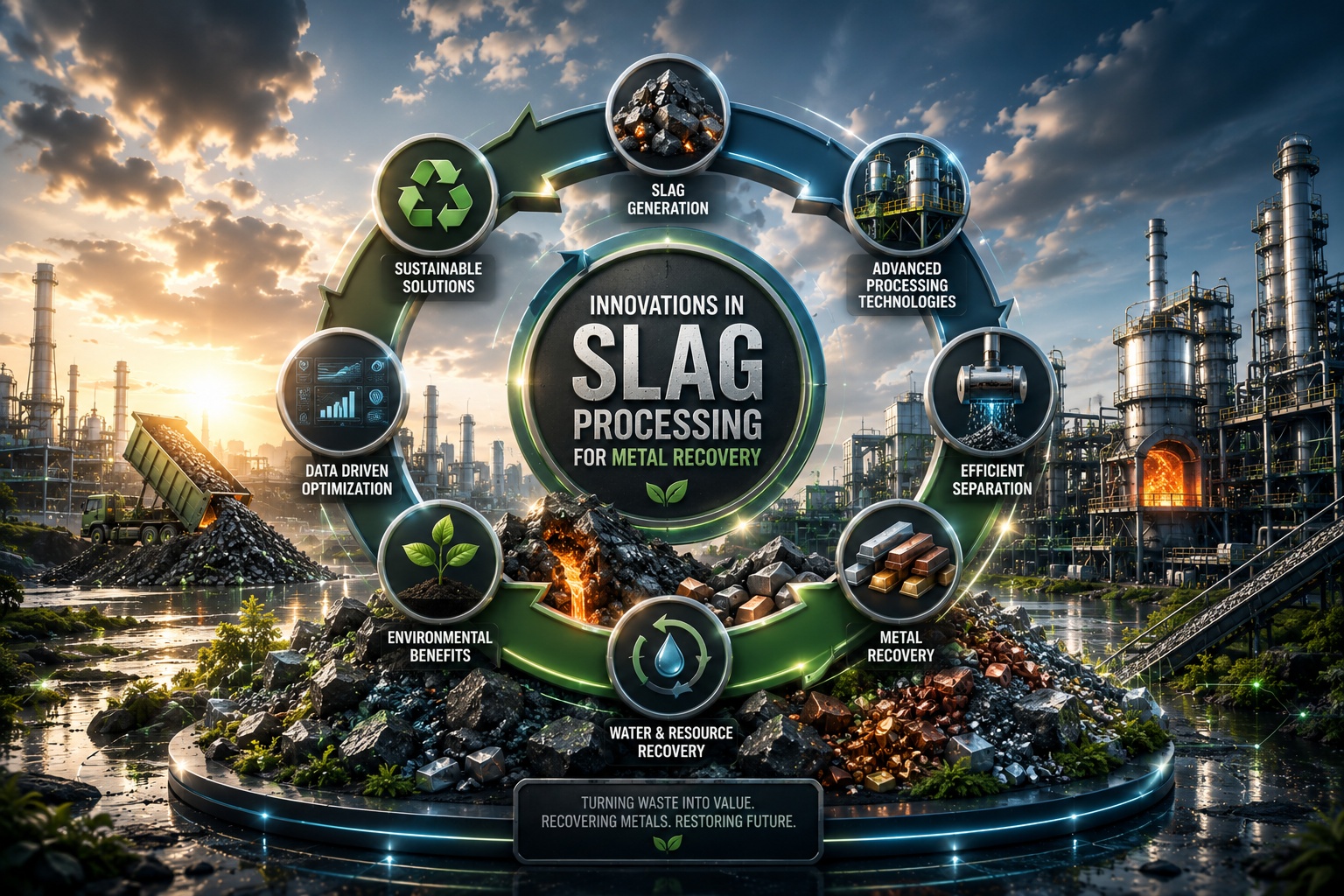
Steelmaking generates millions of tonnes of slag every year — a by‑product that has historically been considered waste. However, modern processing technologies are transforming slag from a liability into a valuable resource, recovering high‑purity metals and minerals for use in construction, refractory, and metallurgical applications.
Slag is produced during the smelting and refining of iron and steel, as well as in the production of ferroalloys. It typically contains significant quantities of iron, chromium, vanadium, manganese, and other valuable elements locked in a complex silicate matrix. Innovations in slag processing are now making it economically viable to recover these metals, reducing landfill waste, cutting carbon emissions, and creating new revenue streams for steel and ferroalloy producers.
Why Slag Processing Matters
The importance of slag processing extends beyond simple waste management. Key drivers include:
- Resource Security: Recovering metals from slag reduces dependence on primary mining and contributes to circular supply chains.
- Environmental Performance: Slag recovery reduces landfill burden, lowers greenhouse gas emissions, and conserves natural resources.
- Economic Value: Recovered metals and minerals can generate significant revenue, offsetting processing costs and improving overall economics.
- Regulatory Compliance: Increasingly stringent regulations on waste disposal are making slag recovery a necessity for many producers.
“Slag is not waste — it is a resource waiting to be unlocked. The innovations we are seeing today are turning what was once a liability into a competitive advantage.” — Dr. Hans Müller, Slag Processing Expert
Traditional Slag Processing Methods
Historically, slag processing has focused on size reduction, magnetic separation, and screening to recover metallic iron and produce aggregate for construction. While these methods are effective for coarse metal recovery, they often fail to recover valuable alloying elements such as chromium, vanadium, and manganese, which are locked in the silicate matrix.
Traditional flowsheets typically include:
- Crushing and Grinding: Reducing the slag to a size that liberates metal particles.
- Magnetic Separation: Removing metallic iron and ferrous materials.
- Screening: Classifying materials by size for different applications.
- Gravity Separation: Using density differences to separate metal from slag.
While these methods are effective for recovering coarse metallic iron, they are limited in their ability to recover alloying elements and produce high‑purity products.
Recent Innovations in Slag Processing
New technologies are dramatically improving the efficiency and economics of slag processing. Key innovations include:
1. Advanced Physical Beneficiation
Modern physical beneficiation techniques are significantly improving metal recovery from slag. These include:
- High‑Intensity Magnetic Separation: Using powerful rare‑earth magnets to recover weakly magnetic materials, including chromium‑bearing minerals.
- Sensor‑Based Sorting: Using X‑ray transmission (XRT) and optical sensors to identify and separate metal‑bearing particles from waste fractions, enabling higher‑value product streams.
- Jigging and Dense Medium Separation: Advanced gravity concentration techniques that separate materials based on density, recovering valuable heavy minerals with high efficiency.
- Froth Flotation: Applying flotation chemistry to recover fine metal‑bearing particles that are not recoverable by gravity or magnetic methods.
2. Pyrometallurgical Processing
High‑temperature processing routes are being developed to recover alloying elements from slag more efficiently:
- Reduction Roasting: Using carbon or other reducing agents to convert metal oxides to metallic forms that can be separated by magnetic or gravity methods.
- Electric Arc Furnace (EAF) Processing: Reprocessing slag in an EAF to recover chromium, vanadium, and iron units, generating a valuable metal product and a clean mineral fraction.
- Smelting and Alloying: Combining slag with other feedstocks to produce ferroalloys directly, eliminating intermediate processing steps.
3. Hydrometallurgical Processing
Aqueous chemistry is increasingly being applied to slag processing, particularly for the recovery of alloying elements:
- Acid Leaching: Using sulfuric, hydrochloric, or nitric acid to dissolve metals from the slag matrix, followed by solvent extraction and precipitation to recover high‑purity products.
- Alkaline Leaching: Using caustic solutions to selectively dissolve amphoteric metals such as vanadium and chromium.
- Bioleaching: Using microorganisms to catalyze metal dissolution, offering a low‑cost, environmentally friendly alternative to chemical leaching.
Hydrometallurgical routes are particularly attractive for recovering chromium and vanadium, as they can achieve high purity and recovery rates while operating at moderate temperatures and pressures.
4. Hybrid Process Flowsheets
The most effective slag processing strategies often combine multiple technologies. For example:
- Physical Beneficiation + Pyrometallurgy: Pre‑concentrating valuable fractions using physical methods, followed by high‑temperature processing to recover metals.
- Physical Beneficiation + Hydrometallurgy: Using physical methods to produce a concentrate, which is then leached and purified to produce high‑purity metal products.
- Integrated Flowsheets: Combining multiple technologies in a single plant to maximize recovery and product quality.
Cirvalor’s Slag Processing Solutions
At Cirvalor, we are at the forefront of slag processing innovation. Our approach combines advanced physical beneficiation, pyrometallurgical, and hydrometallurgical technologies to recover maximum value from slag streams. We offer:
- Slag Characterization: Detailed analysis of slag composition, mineralogy, and recovery potential to design optimal processing flowsheets.
- Customized Processing: Tailored solutions that address the specific characteristics of each slag stream, maximizing metal recovery and product quality.
- Product Development: Producing high‑purity chromium, vanadium, iron units, and refractory raw materials that meet the most demanding customer specifications.
- Circular Integration: Working with clients to return recovered products to their production processes, closing the loop and creating lasting value.
Case Study: Recovering Vanadium from Steel Slag
In a recent project, we partnered with a major steel producer to recover vanadium from their slag. The slag contained approximately 2% vanadium pentoxide, locked in a complex silicate matrix. Our solution combined:
- Physical Beneficiation: Crushing, grinding, and magnetic separation to pre‑concentrate the vanadium‑bearing fraction.
- Pyrometallurgical Processing: Reduction roasting to convert vanadium to a leachable form.
- Hydrometallurgical Processing: Leaching, solvent extraction, and precipitation to produce high‑purity vanadium pentoxide.
The project not only eliminated the client's waste disposal costs but also created a new revenue stream and significantly improved their environmental performance. The recovered vanadium was sold to the energy storage industry, supporting the production of vanadium redox flow batteries.
Looking Forward: The Future of Slag Processing
The future of slag processing is bright. As technology continues to improve and the circular economy gains momentum, slag is increasingly being recognized as a valuable resource rather than a waste. Emerging trends include:
- Digitalization: AI and machine learning are being used to optimize processing conditions, predict performance, and improve quality control.
- Automation: Automated sorting, monitoring, and control systems are reducing operating costs and improving consistency.
- New Product Applications: Recovered materials are finding new applications in advanced ceramics, refractories, and specialty alloys, increasing the value of recovered products.
- Circular Business Models: Companies are exploring new partnership and revenue‑sharing models to accelerate the adoption of slag processing technologies.
At Cirvalor, we are committed to being a leader in this transformation. Our mission is to recover resources, build capability, and serve humanity — and slag processing is a critical part of that mission.
The message is clear: Slag is not waste — it is an opportunity. With the right technology and the right partner, steel and ferroalloy producers can turn their waste streams into value streams, creating economic, environmental, and social benefits for all.