
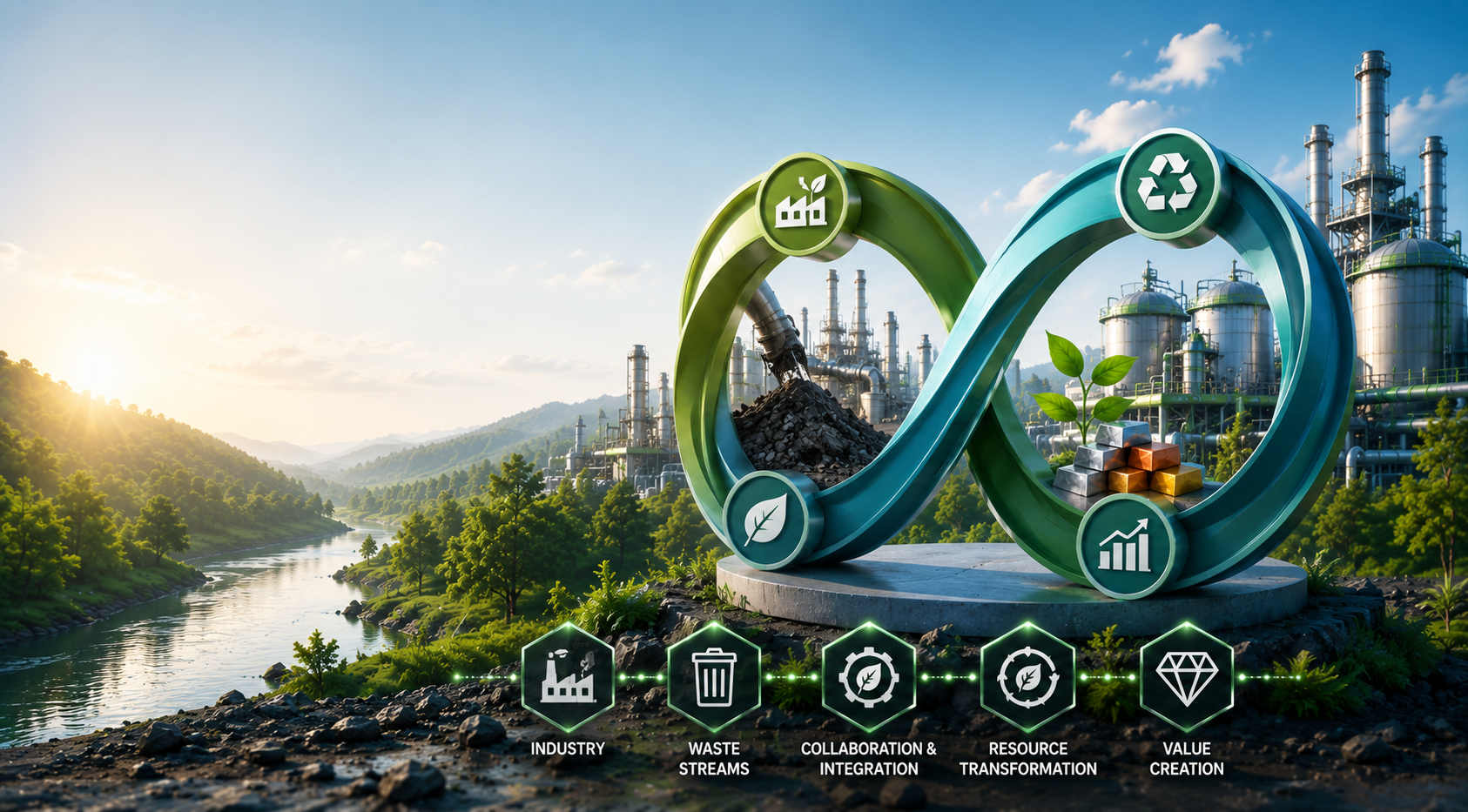
In nature, there is no waste — only resources in transformation. Industrial symbiosis applies this principle to manufacturing, creating interconnected systems where one company's by‑product becomes another's feedstock. This powerful concept is reshaping how industries operate, driving efficiency, reducing environmental impact, and unlocking new economic value.
The linear "take‑make‑dispose" model is no longer viable. As resource scarcity intensifies and regulatory pressures mount, industries are turning to circular approaches that keep materials in use for as long as possible. Industrial symbiosis represents the most advanced form of this thinking — a collaborative ecosystem where waste streams from one process become raw materials for another, creating mutual economic and environmental benefits.
What Is Industrial Symbiosis?
Industrial symbiosis is a strategic approach where different industries, facilities, or sectors collaborate to share resources, energy, water, and by‑products. The goal is to create a closed‑loop system that minimizes waste, reduces reliance on virgin raw materials, and maximizes resource efficiency.
Unlike traditional waste management, which focuses on disposal or downcycling, industrial symbiosis aims to preserve the highest possible value of materials. It requires a shift in mindset — from seeing waste as a liability to recognizing it as an asset that can generate revenue, reduce costs, and improve sustainability performance.
“Industrial symbiosis is not just about recycling. It's about reimagining industrial systems as interconnected ecosystems where nothing is wasted, and everything has value.” — Ellen MacArthur Foundation
Real‑World Examples of Industrial Symbiosis
Some of the most successful industrial symbiosis networks are already delivering measurable results:
- Kalundborg Symbiosis (Denmark): A public‑private partnership where over 20 companies exchange energy, water, and materials, reducing CO₂ emissions by 240,000 tonnes annually and saving millions of euros in waste disposal costs.
- Steel & Cement Integration: Steel slags are increasingly used as raw materials in cement production, reducing both landfill burden and the need for virgin limestone extraction.
- Industrial Ecology Parks: Specialized industrial zones designed from the ground up for resource sharing, where waste heat, steam, and by‑products are seamlessly exchanged between tenants.
- Chemical Industry Partnerships: Spent catalysts from petrochemical refineries are sent to metal recovery facilities for vanadium, molybdenum, and nickel extraction, which are then returned to the same or other industries as raw materials.
Key Benefits of Industrial Symbiosis
When implemented effectively, industrial symbiosis delivers a wide range of benefits:
- Economic: Reduced raw material costs, new revenue streams from waste, lower disposal fees, and shared infrastructure expenses.
- Environmental: Significant reductions in greenhouse gas emissions, water consumption, landfill waste, and resource extraction.
- Social: Job creation in circular economy sectors, stronger community relations, and improved local environmental quality.
- Strategic: Increased supply chain resilience, reduced exposure to raw material price volatility, and enhanced ESG performance.
Cirvalor’s Role in Industrial Symbiosis
At Cirvalor, we are a catalyst for industrial symbiosis. By recovering critical minerals, strategic metals, and industrial materials from complex waste streams, we create bridges between waste generators and end‑users. Our capabilities include:
- Slag Processing: We recover chromium, vanadium, iron units, and refractory raw materials from steel and ferroalloy slags, returning them to the metallurgical supply chain.
- Catalyst Recycling: We extract molybdenum, nickel, cobalt, and vanadium from spent catalysts, reintegrating them into chemical and petrochemical processes.
- Ash Valorization: We process fly ash and bottom ash from power plants into high‑quality materials for cement and construction applications.
- Custom Recovery Solutions: We design tailored recovery routes for unique industrial residues, enabling clients to close their material loops.
By offering end‑to‑end recovery solutions, we enable industrial partners to participate in symbiotic networks without the need for large capital investments in new technologies. Our expertise in metallurgy and resource recovery allows us to transform what was once a costly waste stream into a valuable, tradable commodity.
Building the Industrial Symbiosis of Tomorrow
The transition to a circular economy requires collaboration across value chains. Industrial symbiosis is the practical manifestation of this vision — a proven strategy that delivers both economic and environmental dividends. As regulatory frameworks evolve and consumer expectations shift, companies that embrace industrial symbiosis will be better positioned to thrive in a resource‑constrained world.
At Cirvalor, we are committed to expanding our network of recovery partnerships, developing new technologies, and demonstrating the business case for circular resource management. By turning waste streams into value streams, we are helping industries build resilient, sustainable, and prosperous futures.
The message is clear: the future belongs to those who see opportunity where others see waste. Industrial symbiosis is not just an environmental strategy — it is a competitive advantage.