
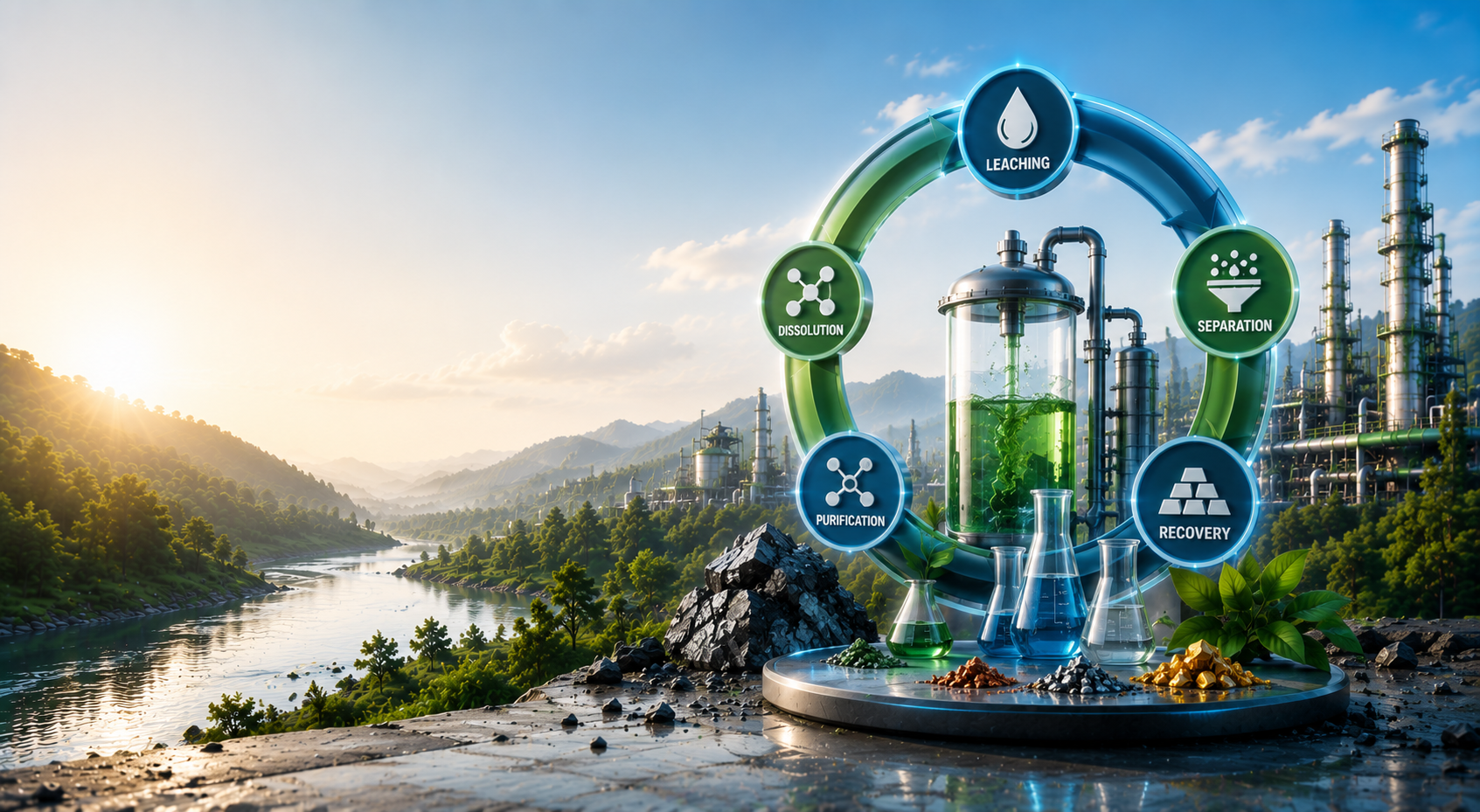
Hydrometallurgy is at the heart of modern resource recovery, offering a versatile and environmentally responsible pathway for extracting critical metals from complex waste matrices. Recent advances in leaching, solvent extraction, ion exchange, and precipitation technologies are revolutionizing how we recover chromium, vanadium, molybdenum, and other strategic materials from industrial by‑products.
As the demand for critical minerals continues to rise, driven by the energy transition and digital transformation, the need for efficient, scalable, and sustainable recovery technologies has never been greater. Hydrometallurgy, which uses aqueous solutions to extract metals from ores, concentrates, and wastes, is uniquely positioned to meet this challenge. Unlike pyrometallurgy, which involves high‑temperature processing, hydrometallurgy operates at lower temperatures, consumes less energy, and can be more selective in metal recovery.
Why Hydrometallurgy Matters for Critical Metal Recovery
Critical metals such as chromium, vanadium, molybdenum, and tungsten are essential for a wide range of applications, from stainless steel and superalloys to batteries, catalysts, and electronics. However, their primary ores are increasingly complex and lower‑grade, making conventional processing less economical and more environmentally damaging.
Hydrometallurgy offers several distinct advantages for recovering these metals from industrial waste streams:
- Selectivity: Aqueous chemistry allows for highly selective separation of target metals from complex matrices, reducing the need for multiple processing steps.
- Energy Efficiency: Ambient or moderate temperature operations significantly reduce energy consumption compared to high‑temperature smelting processes.
- Environmental Performance: Lower emissions, reduced water usage (when properly designed), and the ability to recycle process reagents make hydrometallurgy a cleaner option.
- Flexibility: Hydrometallurgical processes can be adapted to a wide range of feedstocks, from high‑grade concentrates to low‑grade residues.
“Hydrometallurgy is the key to unlocking the full potential of circular economy for metals. It enables us to recover value from waste streams that were previously considered uneconomical.” — Dr. John R. Taylor, Metallurgical Engineer
Recent Advances in Hydrometallurgical Technologies
The field of hydrometallurgy is evolving rapidly, driven by advances in chemistry, process engineering, and digitalization. Some of the most exciting developments include:
1. Enhanced Leaching Systems
Leaching is the first step in most hydrometallurgical flowsheets, where metals are dissolved from solid feedstocks using acids, alkalis, or other lixiviants. Recent innovations include:
- Pressure Leaching: Operating at elevated temperatures and pressures to increase reaction kinetics and metal extraction yields, particularly for refractory materials.
- Bioleaching: Using microorganisms to catalyze the dissolution of metals from sulfidic and refractory ores, offering a low‑cost, environmentally friendly alternative.
- Ultrasound‑Assisted Leaching: Applying ultrasonic energy to enhance mass transfer and reduce leaching times, improving both efficiency and energy consumption.
- Glycine‑Based Leaching: A new class of lixiviants that offer high selectivity for base and precious metals while being less hazardous than cyanide or strong acids.
2. Advanced Solvent Extraction (SX) and Ion Exchange (IX)
Solvent extraction and ion exchange are the workhorses of metal purification and separation. Recent developments include:
- Novel Extractants: New organic reagents with higher selectivity, faster kinetics, and better phase separation characteristics are enabling more efficient recovery of targeted metals.
- Synergistic Solvent Extraction: Combining multiple extractants to achieve exceptional selectivity for metals like vanadium and molybdenum in the presence of iron and other impurities.
- Ion Exchange Resins with Enhanced Selectivity: New resin chemistries and functionalized polymers that can selectively capture specific metals from dilute solutions, reducing the need for downstream purification.
3. Precipitation and Crystallization
After purification, metals are typically recovered as precipitates, hydroxides, or crystalline products. Innovations include:
- Controlled Precipitation: Precise control over pH, temperature, and supersaturation to produce high‑purity, easily filterable products with consistent particle size distributions.
- Continuous Crystallization: Advanced continuous processing strategies that improve product quality and reduce batch‑to‑batch variability.
- Product Engineering: Tailoring the physical and chemical properties of final products to meet specific customer requirements, such as particle size, morphology, and purity.
4. Process Automation and Digitalization
Industry 4.0 technologies are transforming hydrometallurgical operations:
- Online Sensors and Real‑Time Monitoring: Advanced analytical instruments and sensors provide continuous data on process parameters, enabling real‑time control and optimization.
- AI and Machine Learning: Predictive models that optimize leaching, extraction, and precipitation conditions, reducing reagent consumption and increasing yields.
- Digital Twins: Virtual replicas of hydrometallurgical plants that allow operators to simulate different operating scenarios, optimize flowsheets, and train staff without interrupting production.
Cirvalor’s Hydrometallurgical Capabilities
At Cirvalor, we have invested heavily in hydrometallurgical research, development, and operations. Our advanced processing facilities are equipped with state‑of‑the‑art leaching, solvent extraction, ion exchange, and precipitation systems, enabling us to recover high‑purity critical metals from diverse waste streams.
Our team of metallurgists and chemical engineers continuously evaluates and implements new technologies to improve recovery rates, reduce operating costs, and minimize environmental footprint. We are particularly focused on:
- Vanadium Recovery: Using tailored solvent extraction and ion exchange systems to achieve >98% purity V₂O₅ from slag and spent catalyst streams.
- Chromium Recovery: Developing novel leaching and precipitation routes for recovering chromium from ferroalloy and refractory waste.
- Molybdenum Recovery: Implementing advanced SX circuits to selectively extract molybdenum from complex acidic solutions, achieving >99% recovery.
Case Study: Vanadium Recovery from Spent Catalysts
In one of our flagship projects, we designed and commissioned a hydrometallurgical flowsheet for recovering vanadium from spent catalysts generated by the petrochemical industry. The process includes:
- Roasting: Pre‑treatment to convert vanadium to a leachable form.
- Pressure Leaching: High‑efficiency leaching using sulfuric acid under moderate pressure.
- Solvent Extraction: Selective extraction of vanadium using a proprietary extractant blend, achieving >95% recovery.
- Stripping and Precipitation: Recovery of high‑purity ammonium metavanadate, which is calcined to produce V₂O₅.
This flowsheet has enabled our client to reduce waste disposal costs, generate a valuable revenue stream, and significantly improve their ESG performance.
Looking Forward: The Future of Hydrometallurgy
The future of hydrometallurgy is bright. As the circular economy gains momentum and regulatory pressures increase, the demand for efficient and sustainable metal recovery technologies will only grow. Emerging areas such as urban mining, e‑waste recycling, and lithium‑ion battery recycling are opening new opportunities for hydrometallurgical processes.
At Cirvalor, we are committed to staying at the forefront of these developments. Our investment in R&D, our partnerships with leading research institutions, and our relentless focus on process optimization ensure that we continue to deliver world‑class recovery solutions for our clients.
The message is clear: Hydrometallurgy is not just a technology — it is a strategic enabler for the circular economy. By embracing these advances, industries can secure their critical metal supply chains while reducing environmental impact and creating long‑term value.