
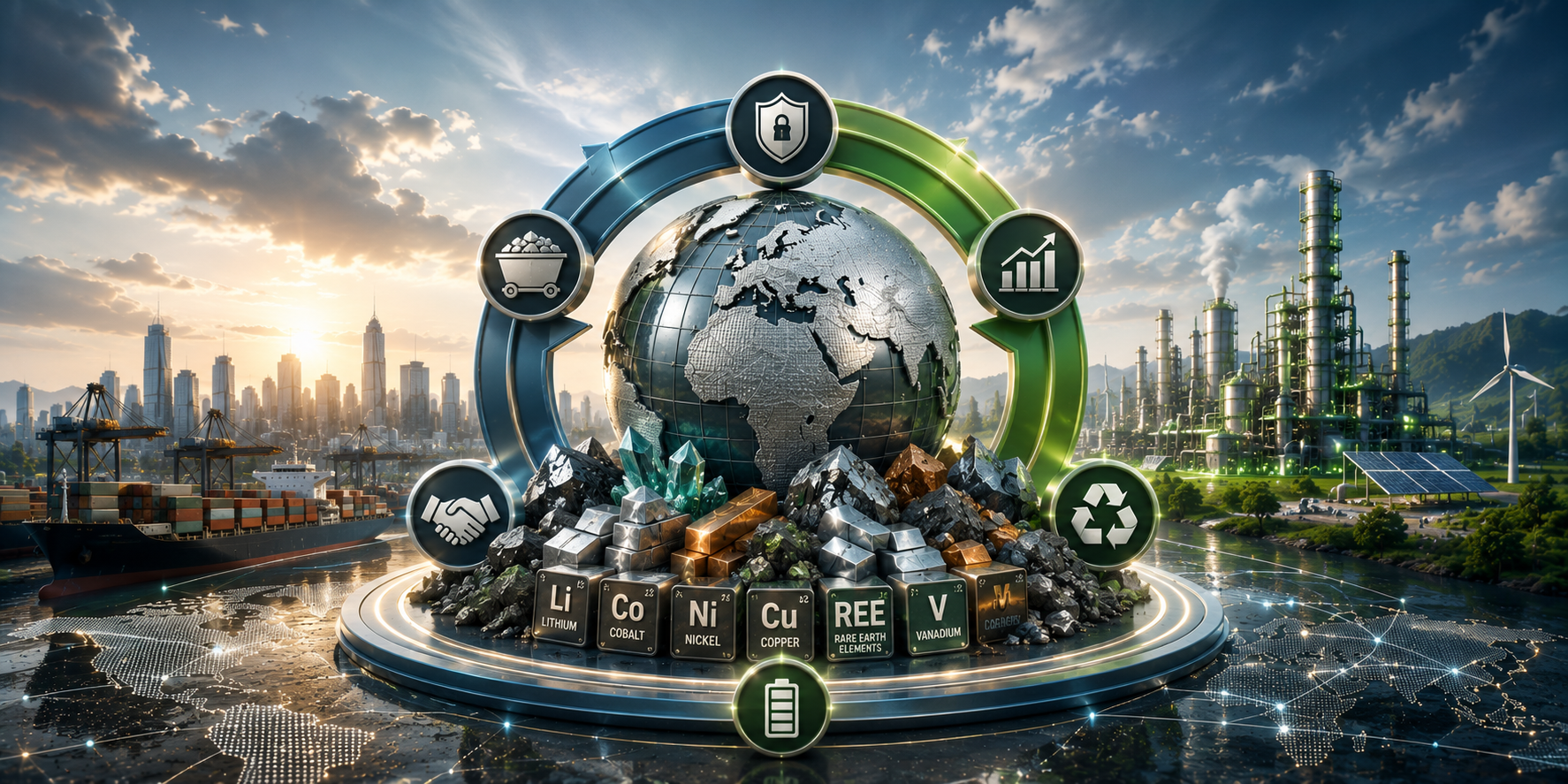
The world is in the midst of a high‑stakes race for critical mineral security. As the energy transition accelerates, the demand for minerals such as lithium, cobalt, nickel, copper, vanadium, chromium, and rare earth elements is soaring. Yet, supply chains remain dangerously concentrated, exposing economies to geopolitical risks, price volatility, and supply disruptions.
Governments and industries are responding with unprecedented urgency. From the US Inflation Reduction Act to the EU Critical Raw Materials Act, policymakers are implementing strategies to secure domestic supply, reduce import dependence, and build resilient circular supply chains. At the heart of this shift lies a fundamental recognition: critical minerals are the new oil — and energy independence now depends on mineral independence.
The Strategic Importance of Critical Minerals
Critical minerals are the building blocks of modern technology and the low‑carbon economy. They are essential for:
- Energy Storage: Lithium, cobalt, nickel, and vanadium are crucial for batteries and grid‑scale storage.
- Renewable Energy: Copper, rare earth elements, and silver are integral to wind turbines, solar panels, and electric motors.
- Defense and Aerospace: Chromium, tungsten, and titanium are vital for jet engines, armor, and advanced alloys.
- Electronics and Communications: Gallium, indium, and germanium are used in semiconductors, fiber optics, and displays.
Despite their importance, the supply chains for many of these minerals are characterized by extreme geographical concentration. For example, China processes over 80% of the world's rare earth elements, and the Democratic Republic of Congo supplies more than 70% of the world's cobalt. This concentration creates significant vulnerabilities — both economic and geopolitical.
“Critical minerals are the new oil. The countries that control their supply chains will shape the 21st century. We must act now to secure our mineral independence.” — Dr. Fatih Birol, Executive Director, International Energy Agency
Geopolitical Tensions and Supply Chain Risks
The concentration of critical mineral supply chains has become a major source of geopolitical tension. Key risks include:
- Export Controls: Major producing countries are increasingly using export restrictions as a strategic tool, disrupting global supply chains and driving up prices.
- Trade Disputes: The US‑China trade war has highlighted the vulnerability of supply chains, with restrictions on rare earth exports causing significant concern.
- Resource Nationalism: Governments in resource‑rich countries are imposing higher taxes, royalties, and ownership requirements, making investment less predictable.
- Supply Chain Bottlenecks: Logistical challenges, insufficient processing capacity, and labor shortages are creating bottlenecks that ripple across industries.
The impact of these risks is already being felt. In 2024, the price of vanadium surged by over 40% following supply disruptions in China. Molybdenum prices have experienced similar volatility, creating uncertainty for steel and chemical manufacturers. For industries that rely on these minerals, supply chain resilience is no longer a luxury — it is a competitive necessity.
Policy Responses: A Global Overview
Governments around the world are implementing comprehensive strategies to address critical mineral security:
United States
The Inflation Reduction Act (IRA) and the Defense Production Act are driving significant investment in domestic mining, processing, and recycling of critical minerals. The US has also established the Critical Minerals Security Alliance to coordinate efforts with allied countries, reducing dependence on adversarial supply chains.
European Union
The EU's Critical Raw Materials Act sets ambitious targets for domestic extraction, processing, and recycling of 34 critical raw materials. The Act also requires member states to identify strategic projects and streamline permitting processes, accelerating the development of domestic supply capacity.
China
China continues to dominate the global critical mineral supply chain, controlling vast reserves and processing capacity. However, the country is also investing heavily in domestic recycling and urban mining, recognizing that secondary resources will be essential for long‑term supply security.
Australia and Canada
Both countries are positioning themselves as reliable suppliers of critical minerals, with significant investments in mining, processing, and research. Their resource‑rich economies and stable regulatory environments make them attractive partners for downstream industries.
India
India is developing its own critical mineral strategy, focusing on securing lithium, cobalt, and rare earth supplies for its growing electronics, defense, and renewable energy sectors. The country is also exploring partnerships with resource‑rich nations and investing in domestic recycling infrastructure.
The Role of Circular Supply Chains
While primary mining will continue to play a role in meeting critical mineral demand, circular supply chains are becoming increasingly important. Recycling and recovery from industrial waste, end‑of‑life products, and urban mining can significantly reduce dependence on primary extraction and mitigate supply chain risks.
The benefits of circular supply chains for critical minerals include:
- Supply Security: Recycling provides a domestic source of materials that is immune to export restrictions and geopolitical tensions.
- Environmental Performance: Secondary production typically consumes less energy and generates fewer emissions compared to primary mining.
- Economic Resilience: Circular supply chains create local jobs, reduce import costs, and stabilize material prices over the long term.
- Strategic Autonomy: A robust circular economy reduces the risk of supply disruptions, ensuring that industries can continue to operate even in times of crisis.
However, achieving a truly circular supply chain for critical minerals requires significant investment in technology, infrastructure, and collaboration. Advanced recovery processes, such as those developed by Cirvalor, are essential for efficiently extracting high‑purity metals from complex waste streams.
Cirvalor’s Contribution to Critical Mineral Security
At Cirvalor, we are directly addressing the critical mineral security challenge. Our recovery solutions transform industrial waste into high‑purity strategic metals and minerals, creating a reliable domestic source of critical materials. By recovering chromium, vanadium, molybdenum, tungsten, and other essential metals from slag, ash, and spent catalysts, we:
- Reduce Import Dependence: Our recovered materials supply domestic industries, reducing reliance on imported primary resources.
- Strengthen Supply Chains: We provide a stable, predictable supply of critical minerals that is insulated from geopolitical risks.
- Support Circular Economy: Our processes close the loop on industrial materials, keeping resources in productive use for as long as possible.
- Enable ESG Goals: Our clients use our recovered materials to meet their sustainability targets and enhance their ESG performance.
Case Study: Securing Vanadium Supply
In response to growing demand for vanadium in energy storage applications, we expanded our vanadium recovery capacity significantly. By partnering with steel and petrochemical producers to recover vanadium from their waste streams, we have created a reliable, domestic supply of vanadium pentoxide that supports the growing battery industry. Our approach reduces the environmental footprint of vanadium production while strengthening energy security.
Looking Forward: The Road Ahead
The global race for critical mineral security is only beginning. As the world transitions to a low‑carbon economy, the demand for critical minerals will continue to grow. Governments will need to accelerate investment in domestic supply chains, support technological innovation, and foster international cooperation. Industries must embrace circularity, invest in recovery infrastructure, and build resilient supply chains that can withstand geopolitical shocks.
At Cirvalor, we are committed to being a cornerstone of the critical mineral security ecosystem. Our mission is to recover resources, build capability, and serve humanity — and in doing so, we contribute to a future where critical minerals are abundant, accessible, and sustainable for all.
The message is clear: The race for critical mineral security is not just about resources — it is about resilience, independence, and the future of global industry. Those who act decisively will lead the next era of innovation and prosperity.